
A listening method for the evenings when asking more gets you less
Don't change your child. Listen differently.
Need Help? [email protected]
When every question gets "Fine," "Nothing," or "I don't know"
"How was school?"
"Fine."
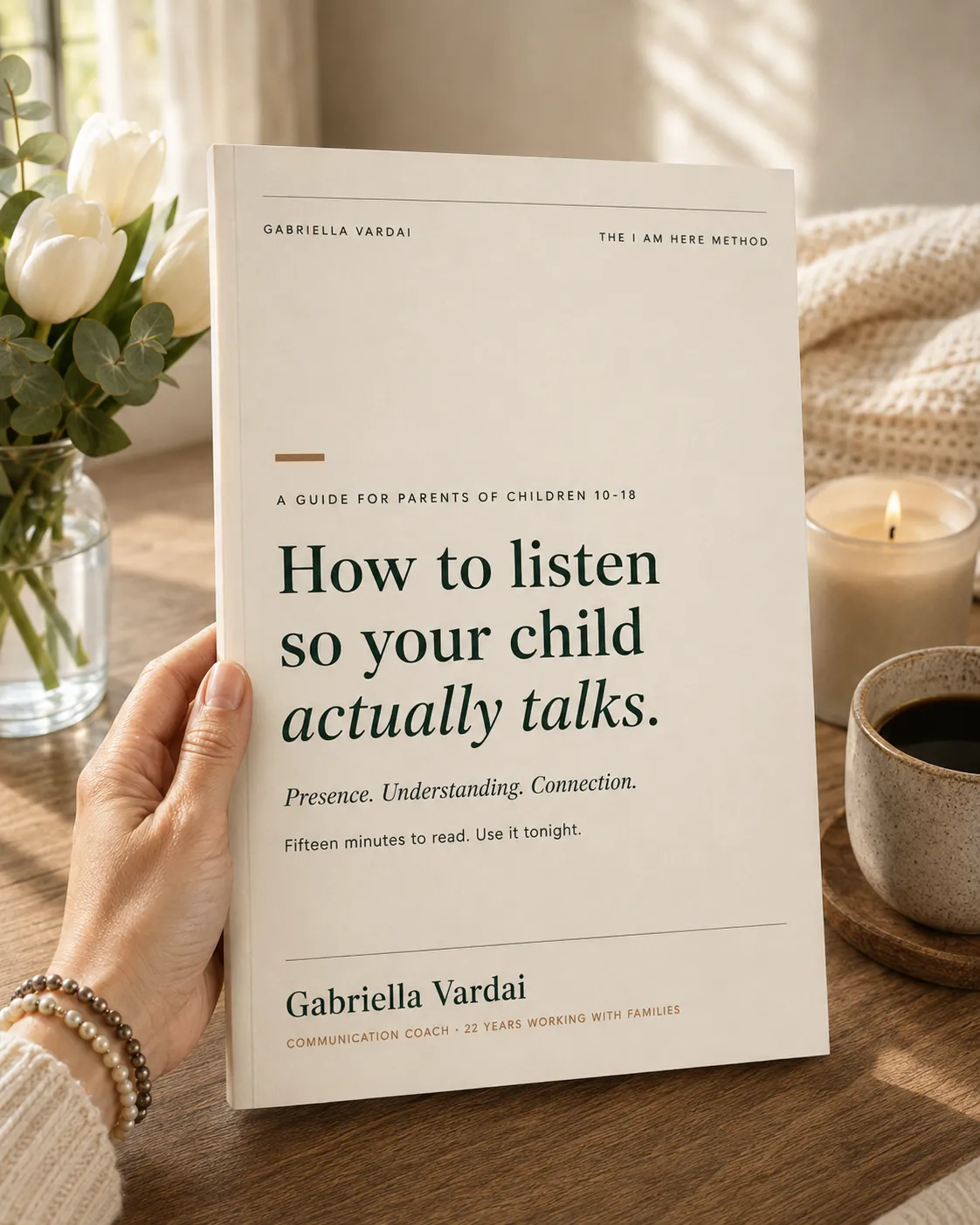
How to Listen So Your Child Actually Talks™
The five-step listening method for the evenings when asking more gets you less. A fifteen-minute guide for parents of children 10 to 18.
In fifteen minutes you will have:
- the five steps, in the order I teach them, and what each one is for
- a way to notice the moment listening turns into asking or fixing, which is where most evenings go
- what to do when it does not land, because the first time usually does not
$13. Start with the first step tonight.
Get the guide, $1330-day guarantee · No subscription · Nothing your child has to do
"I didn't need another question. I gave her room to continue, and we had a real conversation."
Rob, parent
Then the plate goes in the sink, the stairs creak, and you are standing in the kitchen holding the question you did not get to ask.
You may not need a better question.
You may need to change what happens after you ask it.
How to Listen So Your Child Actually Talks™
$13
A fifteen-minute practical guide for parents of children 10 to 18.
Digital access.
30-day guarantee.

You ask because you care
"Are you okay?"
"I don't know."
So you try again. A different question, a softer voice, an explanation that you are only trying to help.
And somehow, the harder you try to have the conversation, the smaller it gets.
If you know that feeling, the problem is probably not the question.
It is what happens right after it.
The moment most of us miss
Your teenager walks in and says:
"School was awful."
You say:
"What happened?"
There is nothing wrong with that question. But notice what just happened.
Your child gave you something, and you immediately asked for something back.
Now they have to answer you, and the conversation has quietly moved from where they were going to where you asked them to go.
Sometimes that works.
Sometimes you get "Nothing," or "Forget it," and the door closes.
This is the moment The I Am Here Method™ teaches you to notice.
I know that helpless feeling from both sides
A mother I have worked with for years told me what so many parents tell me first:
"I think I am being shut out of my own child's life."
So I asked her what she was feeling. Not what her daughter was doing.
She stopped for a long moment.
Then she said:
"I am not angry. I am frightened. I feel helpless, and I do not know what to do with this."
I know that sentence from the inside.
When my own daughter was a teenager, I had the same thoughts, and I had been teaching this work for years by then.
Knowing what to do and doing it at nine at night are two different skills.
"But I already listen."
You probably do.
The hard part is not knowing that listening matters. It is noticing what we do while we are trying to listen.
We ask another question, we reassure, we give advice, we explain what we think happened.
Almost all of it comes from care. And some of it quietly takes the conversation somewhere your child was not going.
The I Am Here Method helps you notice that moment and gives you another move.
What does that look like?
Your teenager says:
"I hate my math teacher."
You could ask:
"Why? What happened?"
You could reassure:
"I'm sure it's not that bad."
You could solve:
"Do you want me to email the school?"
Or you could stay with what they just gave you:
"That sounds rough."
And wait.
The pause may feel strange, especially if you usually help by asking or fixing.
You do not have to fill it.
You don't have to change your child
You cannot make your child talk.
And you do not need to.
There is one part of every conversation you can change:
Your side.
What you do when they start.
What you do with the silence.
Whether you ask, solve, explain, or stay.
Your child does not have to learn anything.
There is no worksheet for them. No exercise they have to complete. No conversation you have to talk them into.
You can start even if they have absolutely no interest in "working on communication."
What you get
How to Listen So Your Child Actually Talks gives you the five steps of The I Am Here Method, in the order I teach them.
You'll learn how to notice when listening turns into questioning or fixing.
What to do instead of automatically asking the next question.
How to stay with what your child is actually saying.
How to use silence without making it awkward.
And how to practice this in ordinary conversations without announcing that you are using a "communication technique."
Read it in about fifteen minutes.
Then use it in one real conversation.
What parents who received the guide told me
"I doubted the approach at first. After trying it two or three times, it started to feel easy, and I got a normal response instead of the reaction I expected."
Josh
"At first I thought, why should I change the way I talk instead of trying to change what my child does? Then I realized my side of the conversation was the part I could actually control."
Mariah
"Staying quiet, listening and validating felt uncomfortable at first. Then my daughter kept talking. For about three minutes. I didn't need another question. I gave her room to continue, and we had a real conversation."
Rob
Shared with permission.
Try it in a real conversation
Read the guide.
Try the first step.
Notice what happens when you change what you do on your side of the conversation.
If you decide it was not worth the $13, write to [email protected] within 30 days and you get your money back.
No form. No reason required.
That inbox is mine.
Your next conversation does not need a perfect question
Sometimes the most useful thing you can do is stay with what your child just said long enough for them to say the next thing.
How to Listen So Your Child Actually Talks
The I Am Here Method
A fifteen-minute practical guide for parents of children 10 to 18.
$13
Get the guide, $1330-day guarantee
Gabriella Vardai
Communication Coach
More than 20 years working with families and communication.
funnel.soulhubs.com is operated by SoulHubs SRL
Registered in Romania · CUI: RO 13617696
Calarasilor 21, 410197 Oradea, Romania
Contact: [email protected]
Privacy Policy · Terms of Sale · Refund Policy · Contact
© 2026 SoulHubs SRL
This site is not a part of the Facebook website or Facebook Inc. Additionally, This site is NOT endorsed by Facebook in any way. FACEBOOK is a trademark of FACEBOOK, Inc.